Compound Sentence Stone Age Hunters Painted Sophisticated Cave Art Near Santander
| UNESCO World Heritage Site | |
|---|---|
 | |
| Location | Santillana del Mar, Cantabria, Spain |
| Function of | Cave of Altamira and Paleolithic Cave Art of Northern Spain |
| Criteria | Cultural: (iii), (i) |
| Reference | 310-001 |
| Inscription | 1985 (9th Session) |
| Extensions | 2008 |
| Buffer zone | 16 ha (0.062 sq mi) |
| Coordinates | 43°22′57″N iv°seven′13″W / 43.38250°North iv.12028°W / 43.38250; -four.12028 Coordinates: 43°22′57″Due north 4°7′13″Due west / 43.38250°N 4.12028°W / 43.38250; -four.12028 |
| Location in Cantabria, Spain Prove map of Cantabria Cave of Altamira (Spain) Show map of Espana | |
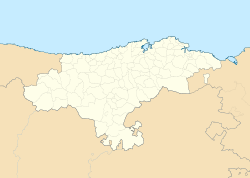

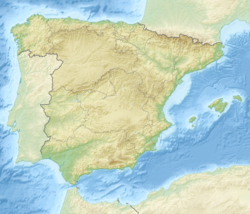
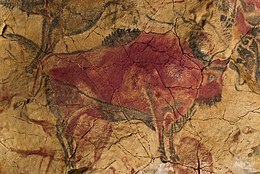
The Cavern of Altamira (; Spanish: Cueva de Altamira [ˈkweβa ðe altaˈmiɾa]) is a cave circuitous, located virtually the historic town of Santillana del Mar in Cantabria, Kingdom of spain. It is renowned for prehistoric parietal cave art featuring charcoal drawings and polychrome paintings of contemporary local fauna and human being hands. The primeval paintings were practical during the Upper Paleolithic, effectually 36,000 years ago.[i] The site was discovered in 1868 by Modesto Cubillas and subsequently studied by Marcelino Sanz de Sautuola.[2]
Aside from the striking quality of its polychromatic art, Altamira's fame stems from the fact that its paintings were the commencement European cave paintings for which a prehistoric origin was suggested and promoted. Sautuola published his inquiry with the support of Juan de Vilanova y Piera in 1880, to initial public acclaim.
However, the publication of Sanz de Sautuola'due south research speedily led to a biting public controversy among experts, some of whom rejected the prehistoric origin of the paintings on the grounds that prehistoric human beings lacked sufficient ability for abstruse thought. The controversy connected until 1902, by which fourth dimension reports of similar findings of prehistoric paintings in the Franco-Cantabrian region had accumulated and the evidence could no longer be rejected.[3]
Altamira is located in the Franco-Cantabrian region and in 1985 was declared a Globe Heritage Site by UNESCO as a key location of the Cave of Altamira and Paleolithic Cave Art of Northern Spain.[iv] The cave can no longer be visited, for conservation reasons, only there are replicas of a section at the site and elsewhere.
Description [edit]
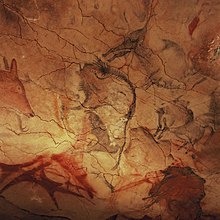
Bison on the roof of the pit.
The cavern is approximately 1,000 m (3,300 ft) long[5] and consists of a series of twisting passages and chambers. The master passage varies from 2 to six meters in height. The cavern was formed through collapses post-obit early karst phenomena in the calcareous stone of Mount Vispieres.
Archaeological excavations in the cavern floor found rich deposits of artifacts from the Upper Solutrean (c.18,500 years ago) and Lower Magdalenian (between c.16,590 and fourteen,000 years ago). Both periods belong to the Paleolithic or Old Stone Age. In the two millennia betwixt these two occupations, the cave was apparently inhabited just by wild animals.
Human occupants of the site were well-positioned to take reward of the rich wild animals that grazed in the valleys of the surrounding mountains as well every bit the marine life available in nearby littoral areas. Effectually thirteen,000 years agone a rockfall sealed the cave's entrance, preserving its contents until its eventual discovery, which occurred after a nearby tree fell and disturbed the fallen rocks.
Homo occupation was limited to the cave mouth, although paintings were created throughout the length of the cave. The artists used charcoal and ochre or hematite to create the images, often diluting these pigments to produce variations in intensity and creating an impression of chiaroscuro. They too exploited the natural contours of the cavern walls to requite their subjects a 3-dimensional effect. The Polychrome Ceiling is the near impressive feature of the cave, depicting a herd of extinct steppe bison (Bison priscus [half dozen]) in unlike poses, two horses, a large doe, and possibly a wild boar.

Smashing hall of polychromes of Altamira, published past Yard. Sanz de Sautuola in 1880.
Dated to the Magdalenian occupation, these paintings include abstract shapes in addition to fauna subjects. Solutrean paintings include images of horses and goats, too equally handprints that were created when artists placed their hands on the cave wall and blew pigment over them to leave a negative image. Numerous other caves in northern Spain contain Paleolithic art, but none is as complex or well-populated as Altamira.
Discovery, excavation, scepticism [edit]
In 1879, apprentice archeologist Marcelino Sanz de Sautuola was led by his eight-year-one-time daughter María to discover the cave's drawings.[vii] The cave was excavated by Sautuola and archaeologist Juan Vilanova y Piera from the University of Madrid, resulting in a much acclaimed publication in 1880 which interpreted the paintings as Paleolithic in origin. The French specialists, led by Gabriel de Mortillet and Émile Cartailhac, were particularly adamant in rejecting the hypothesis of Sautuola and Piera, whose findings were loudly ridiculed at the 1880 Prehistorical Congress in Lisbon.
Due to the high artistic quality, and the exceptional country of conservation of the paintings, Sautuola was accused of forgery, as he was unable to reply why there were no soot (smoke) marks on the walls and ceilings of the cave. A beau countryman maintained that the paintings had been produced by a contemporary artist, on Sautuola's orders. Later, Sautuola found out the artist could have used marrow fat as oil for the lamp, producing much less soot than any other combustibles.
It was non until 1902, when several other findings of prehistoric paintings had served to render the hypothesis of the extreme antiquity of the Altamira paintings less offensive, that the scientific society retracted their opposition to the Spaniards. That year, Cartailhac emphatically admitted his mistake in the famous commodity, "Mea culpa d'un sceptique", published in the journal L'Anthropologie. Sautuola, having died 14 years earlier, did non live to witness his rehabilitation.
Cartailhac went on to write a pair of books about the cave, assisted by Henri Breuil'south hand-drawn reproductions of the paintings. Breuil was a both a Cosmic priest and competent draughtsman, whose connection with the cave is discussed in the offset affiliate of G. G. Chesterton's book, The Everlasting Man.
Further excavation piece of work on the cave was done by Hermilio Alcalde del Río between 1902–04, the German Hugo Obermaier betwixt 1924–25 and finally past Joaquín González Echegaray in 1968.
Dating and periodization [edit]

Association of the animals in the cave of Altamira, by Leroi-Gourhan.
There is no scientific agreement on the dating of the archeological artifacts found in the cave, nor the drawings and paintings, and scientists continue to evaluate the historic period of the cave fine art at Altamira.
In 2008, researchers using uranium-thorium dating plant that the paintings were completed over a period of upward to 20,000 years rather than during a insufficiently brief menstruation.[8]
A later written report published in 2012 based on information obtained from farther uranium-thorium dating research, dated some paintings in several caves in Due north Spain, including some of the claviform signs in the "Gran sala" of Altamira. The oldest sign found, a "large red claviform-similar symbol of Techo de los Polícromos", was dated to 36.16±0.61 ka (corrected), i.e. even so well within the Aurignacian. A red dotted outline horse, besides in the Techo de los Polícromos chamber, was dated to 22.11±0.thirteen ka (starting time Solutrean), establishing that the paintings span a menstruum of more than 10,000 years.[1]
Visitors and replicas [edit]

During the 1970s and 2000s, the paintings were being damaged past the carbon dioxide and water vapor in the breath of the large number of visitors. Altamira was completely closed to the public in 1977, and reopened to limited access in 1982. Very few visitors were allowed in per day, resulting in a three-year waiting list. After light-green mold began to appear on some paintings in 2002, the caves were closed to public access.[nine]
A replica cave and museum were built nearby and completed in 2001 past Manuel Franquelo and Sven Nebel, reproducing the cave and its art. The replica allows a more comfortable view of the polychrome paintings of the main hall of the cave, every bit well equally a selection of pocket-sized works. It also includes some sculptures of human faces that are non visitable in the real cave.[7]
Likewise equally the adjacent National Museum and Research Middle of Altamira there are reproductions in the National Archaeological Museum of Espana (Madrid), in the Deutsches Museum in Munich (completed 1964) and in Japan (completed 1993).
During 2010 there were plans to reopen access to the cavern towards the cease of that twelvemonth.[10] In December 2010, yet, the Spanish Ministry of Culture decided that the cave would remain airtight to the public.[11] This determination was based on advice from a group of experts who had establish that the conservation conditions inside the cave had become much more stable since the closure.
Cultural impact [edit]

A modernistic interpretation of a bison from the Altamira cave ceiling, one of the cave's nigh famous paintings.
Some of the polychrome paintings at Altamira Cavern are well known in Spanish popular culture. The logo used by the autonomous government of Cantabria to promote tourism to the region is based on i of the bisons in this cave. Bisonte (Castilian for "bison"), a Spanish cigarette brand of the 20th century, besides used a Paleolithic mode bison figure along with its logo.
The Castilian comic series Altamiro de la Cueva, created in 1965, are a consequence of the fame of Altamira Cave. The comic series depicts the adventures of a group of prehistoric cavemen, shown as modern people, simply dressed in pieces of fur, a scrap like the Flintstones.
The vocal "The Caves of Altamira" appears on the 1976 album The Royal Scam by jazz-stone band Steely Dan, after covered by soul group Perri.
The mid-20th-century modern dinnerware line Primitive, designed past Viktor Schreckengost for the American pottery company Salem Cathay, was based on the bison, deer, and stick figure hunters depicted in the Altamira cave paintings.
The song "Cuevas de Altamira" (Caves of Altamira) appears on the 1978 album Cuevas de Altamira past the symphonic progressive rock-folk grouping Ibio from Cantabria.
The iconic bison paradigm has been used for the cover of the poetry collection Songs for the Devil and Death past Scottish author Hal Duncan.[12]
The protagonist in Satyajit Ray's film Agantuk was inspired by the charging Bison painting to get out his home and written report tribal people.
In 2007, the caves were selected equally one of the 12 Treasures of Spain, a contest conducted past broadcasters Antena 3 and COPE.[13]
In 2016, British Director Hugh Hudson released the film Altamira (chosen Finding Altamira outside Spain) about the discovery of the caves, starring Antonio Banderas and with music by Mark Knopfler released on the soundtrack album Altamira.[14]
See also [edit]
- 7742 Altamira, asteroid named after the cave
- Art of the Upper Paleolithic
- Chauvet Cave
- Caves in Cantabria
- List of Stone Age fine art
- Paleolithic Cave Fine art of Northern Spain
References [edit]
- ^ a b A. W. G. Pike et al., "U-Series Dating of Paleolithic Art in eleven Caves in Kingdom of spain", Science 336, 1409 (2012), doi:10.1126/science.1219957. "We present uranium-serial disequilibrium dates of calcite deposits overlying or underlying art found in eleven caves, including the United Nations Educational, Scientific, and Cultural Organization (UNESCO) Earth Heritage sites of Altamira, El Castillo, and Tito Bustillo, Spain. The results demonstrate that the tradition of decorating caves extends back at least to the Early on Aurignacian menstruum, with minimum ages of 40.8 k years for a ruby-red disk, 37.iii thousand years for a hand stencil, and 35.6 1000 years for a claviform-like symbol. These minimum ages reveal either that cave art was a part of the cultural repertoire of the start anatomically modernistic humans in Europe or that maybe Neandertals also engaged in painting caves." Table i: Ages are corrected for detritus by using an assumed 232Th/238U activeness of 1.250±0.625 and 230Th/238U and 234U/238U at equilibrium.
- ^ "The discovery of Altamira". Museo Nacional y Centro de Investigación de Altamira . Retrieved 25 September 2018.
- ^ Busch, Simon (Feb 28, 2014). "Prehistoric paintings in Spain's Altamira cave revealed to a lucky few". Cablevision News Network. Retrieved December 19, 2016.
- ^ "Cave of Altamira and Paleolithic Cavern Fine art of Northern Kingdom of spain". unesco. Retrieved December 30, 2016.
- ^ Ian Chilvers, ed. (2004). "Altamira". The Concise Oxford Dictionary of Art (3rd ed.). [Oxford]: Oxford University Press. p. xviii. ISBN0-19-860476-9.
- ^ Verkaar, Eastward. L. C. (nineteen March 2004). "Maternal and Paternal Lineages in Cross-Breeding Bovine Species. Has Wisent a Hybrid Origin?". Molecular Biology and Development. 21 (7): 1165–1170. doi:10.1093/molbev/msh064. PMID 14739241.
- ^ a b Travel Advisory; A Mod Copy Of Aboriginal Masters, The New York Times, iv November 2001
- ^ Grey, Richard (5 October 2008). "Prehistoric cave paintings took up to twenty,000 years to complete". The Daily Telegraph. Archived from the original on 18 October 2014. Retrieved 1 September 2017.
- ^ "Altamira cave paintings to be opened to the public once over again". TheGuardian.com. 26 February 2014.
- ^ "Spain to reopen admission to prehistoric cave paintings < Spanish news | Expatica Espana". Archived from the original on 2011-09-17. Retrieved 2010-06-09 .
- ^ Visita la Cueva de Altamira
- ^ Songs for the Devil and Expiry | Circle Six Archived 2012-08-02 at archive.today
- ^ Gómez, Javier (1 January 2008). "Los 12 Tesoros de España, resultados definitivos y ganadores". Sobre Turismo (in Spanish). Retrieved 24 September 2018.
- ^ "Altamira". Film Music Site. Retrieved 25 May 2019.
Bibliography [edit]
- Curtis, Gregory. The Cavern Painters: Probing the Mysteries of the World's Beginning Artists. New York: Alfred A. Knopf, 2006 (hardcover, ISBN ane-4000-4348-4)).
- Guthrie, R. Dale. The Nature of Prehistoric Art. Chicago: Academy of Chicago Printing, 2006 (hardcover, ISBN 0-226-31126-0).
- McNeill, William H. "Secrets of the Cave Paintings", The New York Review of Books, Vol. 53, No. 16, October 19, 2006.
- Thruway, A. W. G.; Hoffmann, D. L.; Garcia-Diez, M.; Pettitt, P. B.; Alcolea, J.; De Balbin, R.; Gonzalez-Sainz, C.; de las Heras, C.; Lasheras, J. A.; Montes, R.; Zilhao, J. (xiv June 2012). "U-Series Dating of Paleolithic Art in 11 Caves in Spain". Science. 336 (6087): 1409–1413. Bibcode:2012Sci...336.1409P. doi:x.1126/science.1219957. PMID 22700921. S2CID 7807664.
- Sustainable tourism and social value at Earth Heritage Sites: Towards a conservation program for Altamira, Spain. Annals of Tourism Research. Eva Parga-Dans & Pablo Alonso González.
- The Altamira controversy: Assessing the economic impact of a world heritage site for planning and tourism management. Journal of Cultural Heritage. Eva Parga-Dans & Pablo Alonso González.
- The social value of heritage: Balancing the promotion-preservation relationship in the Altamira World Heritage Site, Kingdom of spain. Periodical of Destination Marketing & Direction. Eva Parga-Dans, Pablo Alonso González & Raimundo Otero-Enríquez.
External links [edit]
- Altamira Cavern National Museum In Spanish and English
- The Spanish Cave of Altamira opens – with politics Bradshaw Foundation Commodity
- "Les peintures préhistoriques de la grotte d'Altamira", Cartailhac and Breuil founding article (1903), online and analyzed on BibNum [click 'à télécharger' for English version]
- Human Timeline (Interactive) – Smithsonian, National Museum of Natural History (August 2016)
0 Response to "Compound Sentence Stone Age Hunters Painted Sophisticated Cave Art Near Santander"
Post a Comment